
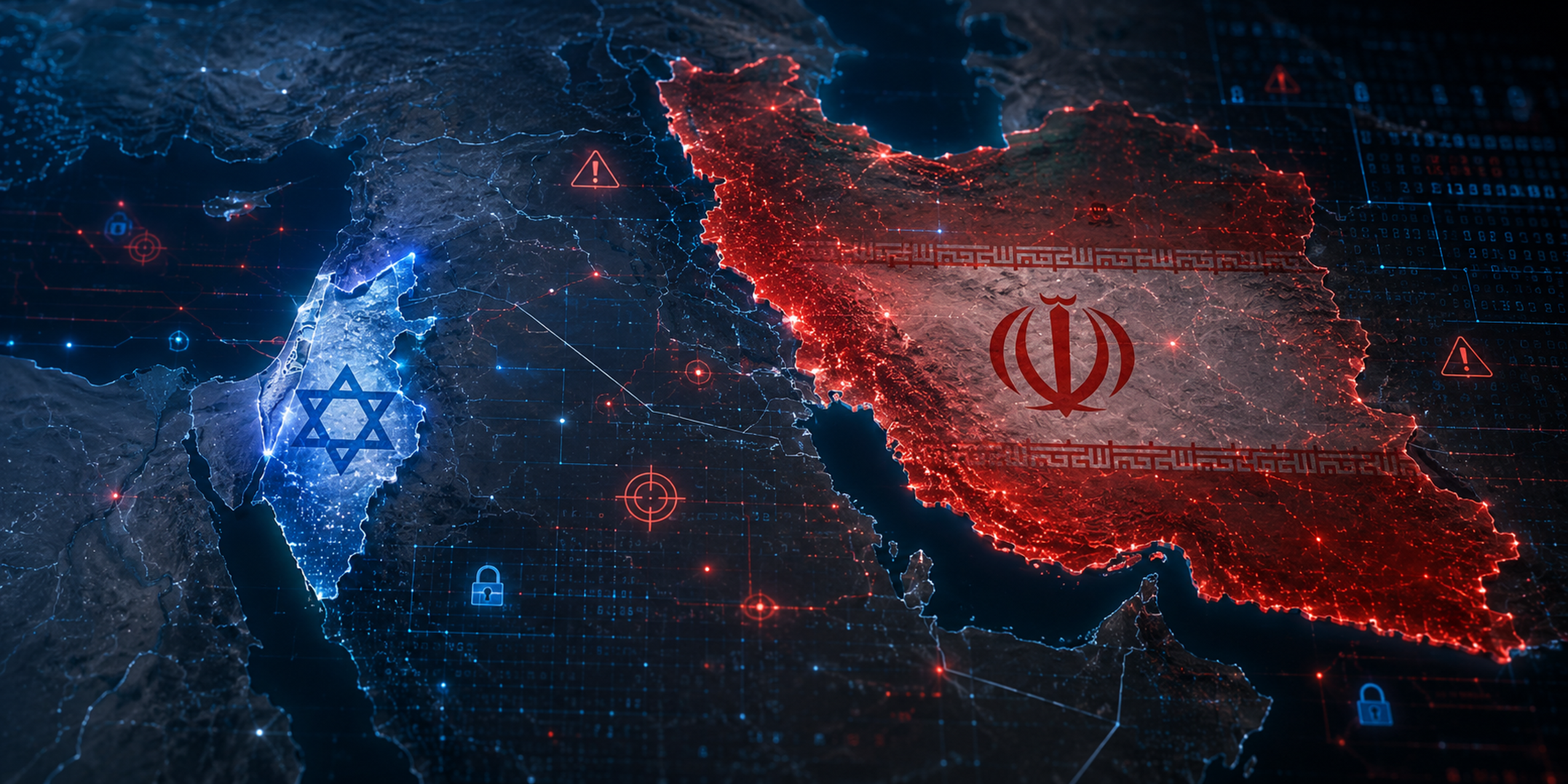
Introduction: The New Architecture of Middle Eastern Conflict
The escalation of military conflict between Iran and Israel in early 2026 has fundamentally altered the security architecture of the Middle East. While the world’s attention has understandably focused on the kinetic exchanges like the ballistic missiles, drone swarms, and precision airstrikes, a parallel and equally consequential war is being waged in the digital domain. This cyber conflict is not merely a sideshow to the physical war; it has become an integral component of how both nations project power, gather intelligence, and impose costs on their adversaries.
For cybersecurity professionals, analyzing the cyber dimensions of the Iran-Israel conflict provides a real-time masterclass in modern state-sponsored cyber warfare. The strategies, tactics, and capabilities deployed by both sides offer critical insights into how cyber operations are evolving from isolated incidents of espionage or disruption into fully integrated components of military doctrine. This integration has profound implications not only for the primary combatants but for organizations globally that find themselves caught in the crossfire of this escalating digital conflict.
The Israeli Approach: Precision Intelligence and Cyber-Kinetic Integration
Israel’s approach to cyber warfare in the current conflict is characterized by deep integration with kinetic military operations, driven primarily by Unit 8200, the elite signals intelligence and cyber warfare division of the Israel Defense Forces. The hallmark of Israeli cyber operations has been the use of digital access to enable physical precision.
The Intelligence-to-Targeting Pipeline
The most operationally significant cyber component of the 2026 conflict has been Israel’s pre-existing access to Iranian domestic infrastructure. According to defense analysts, Israeli intelligence successfully compromised Tehran’s traffic camera network and other municipal surveillance systems long before the current escalation began. This access was not used for immediate disruption but was maintained for long-term intelligence gathering.
When Operation Epic Fury commenced in late February 2026, this digital access proved decisive. The compromised camera networks permitted meticulous pattern-of-life tracking of Islamic Revolutionary Guard Corps (IRGC) commanders and mapped the security posture of key leadership compounds. This intelligence directly enabled the precision strikes that degraded Iran’s military leadership in the opening days of the conflict.
Tactical Disruption and Psychological Operations
Beyond intelligence gathering, Israel has utilized cyber operations for tactical disruption in support of kinetic strikes. During the initial phases of the conflict, mobile phone towers near key Iranian government institutions were systematically disabled. This action served a dual purpose: it severed communications for protection details, preventing them from receiving early warnings of incoming strikes, and it created localized confusion that amplified the psychological impact of the attacks.
Israel has also demonstrated a willingness to engage in direct psychological operations through cyber means. In one notable instance, the BadeSaba prayer application which is used by millions of Iranians to confirm prayer times was compromised to deliver anti-regime messaging. While the strategic efficacy of such operations remains debated, they illustrate a doctrine that views civilian digital platforms as legitimate vectors for psychological warfare.
The Unit 8200 Ecosystem
The sophistication of Israel’s cyber operations is underpinned by the unique ecosystem surrounding Unit 8200. The unit serves as a massive talent incubator, with approximately 1,400 veterans currently working in major US technology firms and thousands more driving Israel’s domestic cybersecurity industry. This revolving door between military intelligence and the commercial technology sector ensures that Israeli state cyber capabilities remain at the cutting edge of technological innovation, particularly in areas like artificial intelligence and vulnerability research.
The Iranian Response: Asymmetric Leverage and Mosaic Defense
Faced with Israel’s technological superiority and the degradation of its conventional military command structures, Iran has leaned heavily on cyber operations as a primary mechanism for asymmetric leverage. Iran’s cyber strategy is designed to impose psychological and operational costs that are disproportionate to the resources expended.
The Mosaic Defense Doctrine
Following the decapitation strikes that severely damaged the leadership of the IRGC and the Ministry of Intelligence and Security (MOIS), Iran’s cyber response demonstrated remarkable resilience. This resilience is the result of Iran’s “mosaic defense” doctrine which is a deliberate strategy of decentralization.
Within hours of the initial US-Israeli strikes, over 60 pro-Iranian hacktivist groups mobilized to launch retaliatory cyberattacks. While many of these groups operate under personas like Handala Hack or the Cyber Islamic Resistance, cybersecurity analysts assess that they function as a pre-positioned proxy ecosystem operating under delegated authority from the Iranian state. This decentralized structure ensures that even when central command facilities are physically destroyed as occurred when Israel struck Iran’s cyber warfare headquarters in eastern Tehran, the capacity to conduct offensive cyber operations remains largely intact.
The Stryker Incident: Bringing the War Home
The most significant demonstration of Iran’s retained high-end cyber capability occurred with the attack on Stryker, a Michigan-based Fortune 500 medical device company. The attack, claimed by the Handala hacktivist persona (operated by Void Manticore, the MOIS’s primary offensive cyber instrument), forced the company to instruct its global workforce to disconnect from all networks. The disruption temporarily paused the transmission of patients’ vital-sign data in some hospitals.
The Stryker attack represents a critical evolution in Iranian targeting strategy. By attacking a US civilian healthcare provider, Iran demonstrated its ability to project power far beyond the Middle East and impose tangible costs on American civilians. The objective was clearly psychological: to exhaust cyber defenders in the United States and undercut political will for the conflict by demonstrating that all civilian infrastructure is now a potential target.
The Illusion of Impact: Hacktivism and Information Control
Despite the genuine threat posed by high-end Iranian APT groups, a significant portion of the cyber activity surrounding the conflict consists of low-level hacktivism. Cybersecurity firms reported a 700 percent increase in cyberattacks targeting Israel following the initial military strikes. However, the vast majority of these attacks were distributed denial-of-service campaigns or website defacements.
Scholars of cyber warfare characterize these operations as “cognitive, not coercive.” They function as digital graffiti, designed to shape the information environment and project an image of capability rather than achieve meaningful military objectives. This aligns with Iran’s broader strategy of information control, which included imposing a near-total internet blackout across the country dropping traffic by 97 percent to prevent the circulation of footage showing the impact of Israeli strikes and to quash internal dissent.
The Global Spillover: Implications for Organizations Worldwide
The cyber dimensions of the Iran-Israel conflict are not contained within the borders of the Middle East. The strategies employed by both sides have created a complex threat environment with significant implications for organizations globally.
The Expansion of the Target Matrix
The most immediate concern for cybersecurity professionals is the rapid expansion of the target matrix. Organizations that have no direct involvement in the conflict, and no presence in the Middle East, are finding themselves targeted. The Stryker incident demonstrates that Iranian state-aligned actors view Western critical infrastructure, healthcare providers, and manufacturing sectors as legitimate targets for retaliatory operations.
This spillover effect is exacerbated by the decentralized nature of Iran’s proxy ecosystem. While state intelligence services may exercise restraint to avoid crossing red lines that would trigger severe kinetic retaliation, hacktivist groups operating with delegated authority may lack such discipline. This creates a volatile environment where attacks on Western commercial entities can occur unpredictably.
The Blurring of State and Criminal Activity
The conflict has also accelerated the blurring of lines between state-sponsored cyber warfare and financially motivated cybercrime. Iranian ransomware groups, such as Pay2Key, have reportedly offered larger profit shares to affiliates willing to conduct attacks against targets in Israel and the United States. This convergence allows the Iranian state to harness the capabilities of the cybercriminal underground to achieve geopolitical objectives while maintaining a veneer of plausible deniability.
For defenders, this means that an attack appearing to be standard financially motivated ransomware may actually be a state-directed disruptive operation. The incident response playbooks for these two scenarios differ significantly, complicating the task of network defense.
The Geopolitical Audience: Russia and China
The cyber operations in the Iran-Israel conflict are being closely monitored by other global powers, serving as a real-time laboratory for future conflicts. Cybersecurity firms have detected Russian hacker groups, such as Z-Pentest, disrupting US networks in apparent support of Tehran. For Russia, the conflict provides a low-cost opportunity to impose burdens on US cyber defenders without incurring significant escalatory risk.
More consequentially, the People’s Republic of China is utilizing the conflict as an unprecedented intelligence-collection opportunity. Beijing is observing how US and Israeli cyber capabilities perform under wartime conditions, analyzing the integration of cyber and psychological operations, and studying the effectiveness of long-term intelligence-gathering tactics. The lessons learned in the Middle East today will undoubtedly inform Chinese cyber doctrine regarding potential future conflicts, particularly concerning Taiwan.
Conclusion: Navigating the New Reality
The cyber operations witnessed in the 2026 Iran-Israel conflict confirm that the integration of digital and kinetic warfare is no longer theoretical; it is the established baseline for modern conflict. For Israel, cyber capabilities provide the precise intelligence necessary to maximize the effectiveness of kinetic strikes. For Iran, cyber operations offer a resilient, asymmetric mechanism to project power globally and impose costs on technologically superior adversaries.
For cybersecurity professionals outside the immediate conflict zone, the lessons are stark. The concept of being a “non-combatant” in cyberspace is increasingly obsolete. As nation-states leverage decentralized proxy networks and target civilian infrastructure to achieve psychological objectives, organizations across all sectors must elevate their defensive posture.
The conflict demonstrates that cyber resilience cannot be achieved through perimeter defense alone. Organizations must assume that highly capable, state-aligned actors are actively seeking access to their networks, not necessarily for immediate exploitation, but to pre-position themselves for future geopolitical contingencies. In this new reality, robust threat intelligence, rapid incident response capabilities, and a deep understanding of the geopolitical threat landscape are no longer optional. They are imperative for survival.
References
[1] The Soufan Center. “Cyber Operations as Iran’s Asymmetric Leverage.” March 17, 2026.
[2] Niti Shastra. “Unit 8200: Israel’s Elite Cyber Intelligence Powerhouse.” April 23, 2026.
[3] Axios. “Hackers join U.S. and Israel’s fight with Iran.” March 11, 2026.
[4] Center for Strategic and International Studies (CSIS). “How Will Cyber Warfare Shape the U.S.-Israel Conflict with Iran?” March 3, 2026.
[5] Atlantic Council. “What the Israel-Iran conflict revealed about wartime cyber operations.” July 30, 2025.